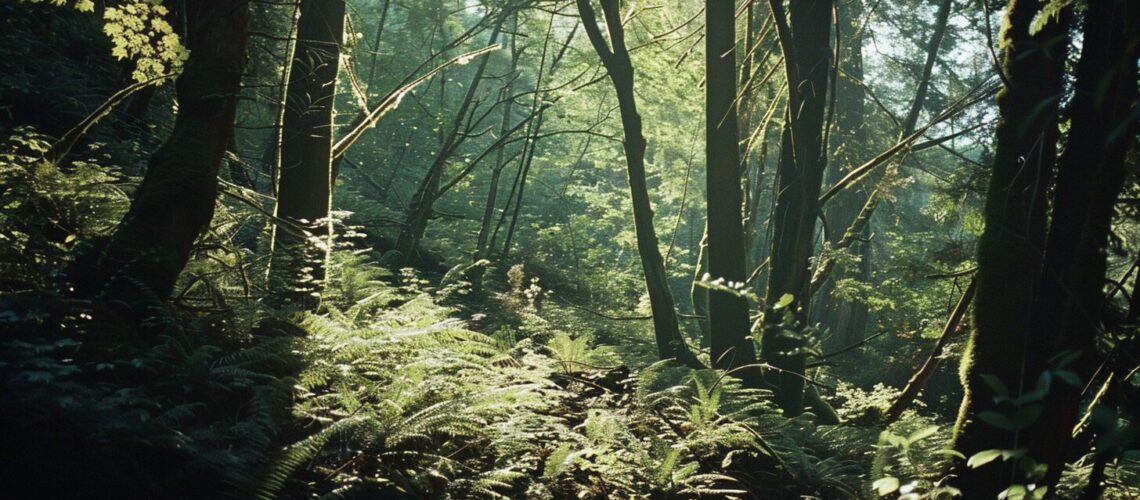
Stand in an old growth forest and close your eyes. You will not hear one sound. You will hear dozens, layered on top of each other. Wind moving through different heights of canopy. A woodpecker working a snag somewhere off to your left. Insects at a pitch just under the birds. Water, maybe, if there is a creek nearby. None of it is loud. All of it is happening at once, in a kind of loose, overlapping order that no single sound could create on its own.
Now stand on a parking lot beside a six lane road. You will also hear one continuous sound. It has almost no layers at all.
Here is the idea we want to sit with today: the difference between those two places is not really about volume. It is about diversity. And a growing body of research suggests that the variety of sound in an environment, not just its loudness, may be one of the clearest signals of whether that environment is healthy, for the ecosystem and for us.
The Problem With Judging a Soundscape by Its Volume Alone
Most of the public conversation about sound starts and ends with decibels. Too loud, bad. Quiet, good. It is an understandable shorthand, and noise pollution is a real and under-addressed public health issue. But volume alone tells you almost nothing about what a soundscape is actually doing to the people and creatures living inside it.
A 65 decibel waterfall and a 65 decibel generator register at the same loudness on a meter. They do not register the same way in a nervous system. One tends to calm us. The other tends to fray us. The meter cannot tell the difference. Our bodies can.
This is where sound diversity becomes a more useful lens than volume ever was. Ecologists have been building this case for years, and it turns out that a rich, varied acoustic environment behaves very differently than a flat, repetitive one, even at identical loudness.
What the Research Actually Shows
Soundscape ecologists commonly describe an environment’s acoustic makeup in three layers: biophony, the sounds made by living creatures; geophony, sounds from natural forces like wind, rain, and moving water; and anthrophony, the sounds humans and our machines produce. A healthy, diverse soundscape usually has all three in some kind of balance. A degraded one tends to be dominated almost entirely by anthrophony, flattened into a single droning layer.
There is now real evidence connecting that diversity to how we feel. A 2026 study in the journal Landscape and Urban Planning had 195 residents in Germany listen to forest recordings with either low or high animal vocal richness. The recordings with greater actual acoustic diversity produced measurably higher well-being, more awe, and a stronger sense of restoration than the sparser recordings, particularly when the forest sounded like one the listener could recognize as their own regional landscape.
Separate laboratory research published in Scientific Reports compared forest soundscapes directly against industrial ones and found the forest recordings consistently improved mood, attention, and a person’s sense of psychological recovery. A broader systematic review pulling together studies across urban, natural, and virtual settings found the same pattern holding up again and again: natural, varied soundscapes helped people’s stress levels recover faster than exposure to anthropogenic noise did.
And diversity is not only a human comfort measure. It doubles as an ecological one. Researchers monitoring forests in Singapore during a period of severe regional haze found that natural acoustic activity dropped by as much as 37.5 percent at the peak of the pollution event, a decline that tracked closely with the stress the fires were putting on the wildlife itself. When the biophony thins out, something real is usually happening to the community producing it.
The Reframe: Diversity, Not Just Quiet, Is the Goal
Here is the part worth sitting with a little longer, because it complicates the simple story. That same 2026 study found something counterintuitive: when people perceived a soundscape as complex or busy without being able to identify it as wildlife, that perceived complexity actually lowered their sense of well-being. More sound is not automatically better. Unrecognized chaos and genuine diversity are not the same experience, even when they might look similar on a spectrogram.
This is the distinction we think matters most. The goal of a healthy soundscape is not maximum quiet, and it is not maximum sound either. It is legibility. A varied environment where a listener can pick out layers, the birds from the wind from the distant traffic, tends to read as alive and restorative. A flattened environment, whether that flatness comes from total silence or from a wall of undifferentiated noise, tends to read as depleted.
Think of it the way you might think about a diverse diet or a diverse ecosystem. It is not the sheer quantity of inputs that matters. It is the range, the balance, and whether each part still has room to be heard.
What This Looks Like in Practice
You do not need a research grant to start noticing this in your own life. A few places to start:
Listen for layers, not just loudness. Next time you step outside, try to count the distinct sound sources you can pick out rather than rating the scene as simply loud or quiet. Three layers reads very differently than one, even at the same volume.
Protect the quiet spaces that let diversity register. A single quiet pocket in a park or a neighborhood is not just pleasant on its own. It is often what makes the more layered sounds around it audible and legible in the first place. [Internal link: Listening to Your Neighborhood: A Beginner’s Guide to Soundwalking]
Notice what is missing, not just what is present. A soundscape that has gone quiet in an unusual way, where birdsong used to be and now is not, is often telling you something about the health of that place. [Internal link: The Sounds We’re Losing: Preserving Our Auditory Heritage]
Bring diversity indoors on purpose. If you work or live in a space dominated by a single flat hum, from HVAC systems or traffic, look for small ways to reintroduce variety: a window cracked for birdsong, a different room for part of the day, even recorded natural sound used thoughtfully rather than as constant background filler.
The Sound of a Healthy Place
A forest does not stay quiet to be healthy. It stays varied. That is the shift we would love for more people to make: stop asking whether a place is loud or quiet, and start asking whether it is diverse. Whether the birds, the wind, the water, and the human hum all still have room to be distinct from each other.
That is what a healthy soundscape actually sounds like. Not silence. Not noise. Something closer to a conversation with many voices, each one still audible on its own.
Want to start noticing the diversity in your own soundscape? Sign up for our newsletter for weekly listening prompts and field notes from the sonic world, or explore our Sound Library to hear the difference between a flattened soundscape and a diverse one for yourself.