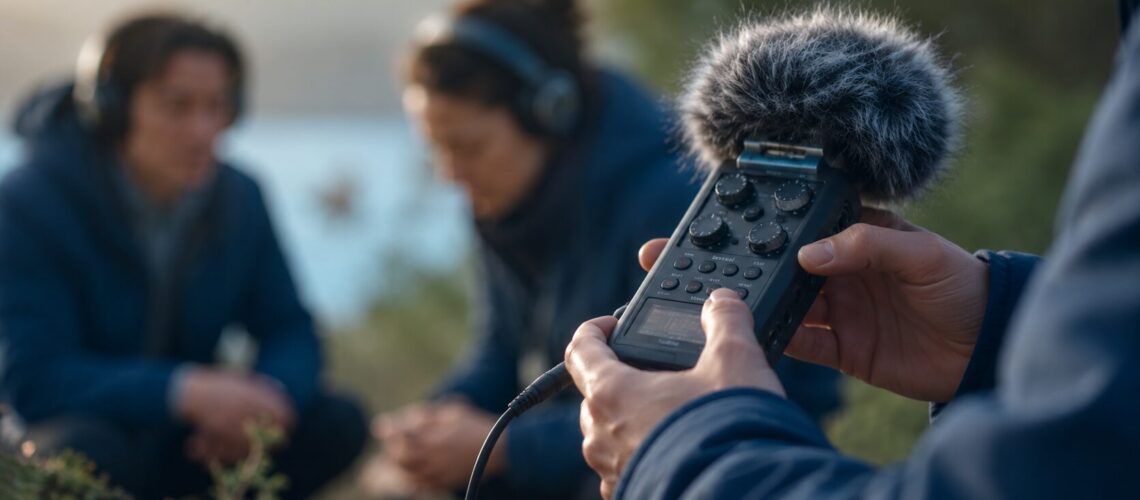
A beginner’s guide to capturing the sounds of your neighborhood, one recording at a time.
I’ve been making field recordings for most of my life, and the question I get asked most often isn’t about gear. It’s some version of “where do I even start?” People assume the answer involves an equipment list. It doesn’t.
Here’s the direct answer to the question in the headline: you start field recording by picking up whatever recorder is already within reach, even the one in your phone, finding a spot, pressing record, and staying quiet longer than feels natural. No special gear required, no formal training, no perfect location to hunt down first. Field recording isn’t about chasing exotic sounds somewhere far away. It’s about paying real attention to the ordinary ones you already live inside, which is the same lesson whether you’re picking up a recorder for the first time or you’ve been doing this for twenty years.
Key Takeaways
- You don’t need professional equipment to start. A smartphone voice memo app captures a completely usable first soundscape recording.
- The biggest beginner mistake isn’t a bad microphone, it’s impatience. Most soundscapes need three to five minutes to reveal what they’re actually made of.
- Good recordings capture three layers at once: foreground, mid-ground, and background. Once you can point a microphone with that in mind, everything changes.
- This isn’t just a nice feeling. Research backs it up: natural and community soundscapes measurably lower stress and support attention recovery.
- Your neighborhood’s soundscape is disappearing faster than you’d think. Recording it now is a small act of preservation, not just a hobby.
Why Don’t We Notice the Sounds Around Us?
Here’s the honest problem: most of us are sound-blind. Not deaf, just untrained. We filter out the refrigerator hum, the traffic two streets over, the specific rhythm of footsteps on our block, because our brains are wired to tune out anything that isn’t a threat or a task. It’s efficient. It’s also how you can live somewhere for years and never really hear it.
I lead soundwalks through Community HiFi, and the pattern is nearly universal. People arrive certain their neighborhood is quiet, or certain it’s just noise, full stop. Then we stand still for five minutes with nothing to do but listen, and something shifts. Someone will say “I didn’t know there were that many birds here,” or “I never noticed the bus makes that sound when it brakes.” They’re not discovering new sounds. They’re discovering they’d stopped listening to the ones that were always there. I wrote more about how to run this kind of guided soundwalk if you want to try it with a group before you ever pick up a recorder.
Once you start recording your soundscape instead of just passing through it, you can’t really go back to not hearing it. That’s not a small thing.
What Does the Research Say About Listening to Soundscapes?
The idea that soundscapes affect us isn’t just a feeling, it’s backed by a growing body of research. A 2021 review published in the Proceedings of the National Academy of Sciences pulled recordings from 66 US national parks, played them for participants across 11 countries, and found a consistent reduction in stress and annoyance from natural soundscapes. A separate 2021 meta-analysis comparing bird sounds and water sounds found each had its own strength: bird sounds produced the largest effect on stress and annoyance, while water sounds had the largest effect on health and positive mood.
Brain-based research backs this up too. One study using EEG measurements found that locations dominated by birdsong produced a stronger presence of the restorative alpha brainwave rhythm than locations dominated by traffic noise, and that this pattern lined up with how stressed people said they felt. That’s not a metaphor. Your brain responds differently depending on what your neighborhood sounds like, which is part of what I mean when I talk about sonic wellness as something concrete, not just a nice phrase.
None of this is new territory for the field, either. Composer R. Murray Schafer founded the World Soundscape Project at Simon Fraser University in the late 1960s, essentially inventing the discipline that treats soundscapes as something worth studying and protecting, not just background noise. His team spent years documenting soundscapes that have since changed or disappeared entirely, work I think about often when I write about the sounds we’re losing. What Schafer understood decades ago is the same thing I see on every soundwalk: once people learn to actually listen, they start advocating for the soundscapes worth keeping.
From Listening in Layers to Recording in Layers
If you’ve read my piece on soundwalking, you already know I teach people to listen in three layers: foreground, the closest and loudest sound; mid-ground, present but not dominant; and background, the sound so constant or distant that you usually filter it out completely. That framework is about training your ears. This is about what happens once you add a microphone.
Here’s the part that’s specific to recording, and the part that trips up almost everyone starting out: a microphone doesn’t hear the way your ears do. Your brain automatically balances foreground, mid-ground, and background so a conversation doesn’t get drowned out by the wind. A microphone has no such loyalty. It captures whatever is loudest and closest, full stop, which is exactly why beginner recordings so often come back sounding flat, all foreground, no depth.
The fix isn’t better gear, it’s positioning. Before you press record, do the same layer-check I teach on a soundwalk: name one sound in each layer with your eyes closed. Then think about where your microphone needs to sit to catch all three, not just the loudest one. Sometimes that means stepping back from the obvious sound instead of moving toward it. A recording with real depth almost always comes from a recordist who backed up.
What Changes Once You Start Recording Instead of Just Listening
I’ve watched this shift happen inside our summer camps more than once. A parent told me her son used to record thirty-second clips of whatever was loudest and call it finished. Once he understood that a microphone needed help balancing the layers his ears did automatically, he started recording in five-minute stretches, and the clips he brought back actually had shape to them: a beginning, a middle, something worth naming.
The same shift shows up in our corporate workshops. Teams come in thinking of sound as an annoyance to manage, an open-office problem to solve. By the end, they’re identifying the specific layers of their workspace soundscape and talking about which ones support focus and which ones erode it. That reframe, from sound as noise to sound as something you can understand and shape, is the engine behind everything Community HiFi does.
Practical Steps to Start Field Recording Today
1. Start with the device already in your pocket. A smartphone voice memo app is a completely legitimate way to make your first ten recordings. Don’t wait for equipment. Wait until you have a habit, then upgrade.
2. Pick one spot and commit to it. Your porch, a park bench, the corner outside your office. Familiarity helps you notice what’s normal versus what changes day to day.
3. Record for at least three minutes, ideally five. The interesting layers of a soundscape don’t show up in the first thirty seconds. Set a timer so you’re not tempted to check your phone and stop early.
4. Close your eyes before you press record. Spend sixty seconds naming one foreground sound, one mid-ground sound, and one background sound. That tells you where to point your microphone, and often, where to step back from.
5. Protect your recording from wind and handling noise. A cheap foam windscreen, or even a wool sock over your phone’s microphone, will save an otherwise good recording. Keep your hands still once recording starts.
6. Let the recording start and end with a few seconds of silence. That gives the listener a doorway into the soundscape instead of dropping them into the middle of it.
7. Listen back with headphones, not speakers. Headphones reveal the layers you actually captured versus the ones you only imagined were there. This is where you learn the most about your own instincts. If you want to hear the difference time of day makes, try the same spot right before sunrise, when the dawn chorus is at its fullest, and compare it to a midday recording from the same bench.
Frequently Asked Questions
Do I need a special microphone to start field recording? No. A smartphone with a basic recording app captures a completely usable first soundscape. Dedicated recorders and external microphones help later, once you know what kind of sounds you actually want to capture and how you want to use them.
What is the biggest mistake beginners make when recording a soundscape? Stopping too soon. Most people record for thirty seconds and move on, before the mid-ground and background layers have had a chance to reveal themselves. Aim for at least three minutes, and treat the first minute as warm-up, not the finished product.
Is field recording the same thing as recording nature sounds? Not exactly. Nature recording is one type of field recording, but urban soundscapes, neighborhood sounds, and community gathering places are just as valid, and often more revealing, since we tend to tune those out the most.
Why does field recording matter beyond just being a hobby? Soundscapes change and disappear the same way physical landscapes do. A sound that defines a place today, a specific train horn, a particular birdsong, a corner store’s door chime, may not be there in ten years. Recording it is a small act of preservation.
Can field recording actually reduce stress? Research suggests the soundscapes themselves can, particularly ones with birdsong or water. The act of recording adds something extra: it forces focused, present-moment listening, which is its own form of attention restoration separate from what you eventually capture.
Your Neighborhood Is Worth Listening To
Go stand somewhere ordinary. Your street, your break room, the bus stop you pass twice a day. Press record, then do the hardest part: nothing. Let the foreground settle. Let the mid-ground arrive. Let the background finally get its chance to be heard. You won’t capture something perfect on your first try. You’ll capture something true, and that’s worth more.
This is the same practice I’ve built a career around, and it still surprises me every time. No two recordings from the same spot ever come back identical. The soundscape around you isn’t backdrop. It’s the sound of a place being alive, and it’s changing every single day, whether you’re listening or not.
Press record anyway.
Keep Learning
- Listening to Your Neighborhood: A Beginner’s Guide to Soundwalking: the full layers framework this piece builds on, and how to run it as a guided group walk.
- The Sounds We’re Losing: Preserving Our Auditory Heritage: why documenting the soundscapes around you matters beyond the recording itself.
- What Is Sonic Wellness? A Beginner’s Guide to Auditory Health: the research and framework behind why listening well supports well-being.
- The Sound of Morning: Why Dawn Chorus Matters: the best possible testing ground for the layering technique in this piece.