
Close your eyes now and listen for ten seconds.
What do you hear?
If you’re like most people, you might say “cars” or “nothing much” or “it’s pretty quiet.” Maybe you mention something bothering you: “the neighbor’s dog” or “traffic.”
But your neighborhood’s sound is far more complex than that. It features rhythms, textures, and patterns. It has a sonic personality as unique as its architectural style.
You already know this sound well. You just might not have the words for it.
This matters more than you realize. When developers suggest new projects, when the city plans infrastructure, or when neighbors argue over noise, the people with the strongest vocabulary often have the most influence. If you can only say “it’s too loud,” you’re at a disadvantage compared to someone who can say “the low-frequency rumble from idling delivery trucks between 6 and 8 AM disrupts sleep and rattles windows.”
Both describe the same problem, but only one gets taken seriously.
Let’s give you the language to describe what you’re already hearing.
The Three Basic Qualities of Sound
Every sound has three qualities you can describe.
Volume (loud or soft) is what most people notice first. But here’s what matters: something can be quiet and still be intrusive. A dripping faucet at night, a neighbor’s TV through the wall, a humming streetlight. Volume isn’t everything.
Pitch (high or low) High sounds: birds, children’s voices, bicycle bells, backup beepers Low sounds: traffic rumble, bass from music, HVAC units, truck engines
Low-frequency sounds travel farther and penetrate walls more easily. This is why freeway noise impacts neighborhoods miles away.
Duration (constant, intermittent, or rhythmic) Constant: freeway hum, air conditioning. Intermittent: car horns, door slams, sirens. Rhythmic: footsteps, train crossing bells, construction hammering.
Our brains adapt to constant sounds. Intermittent sounds still grab our attention. Rhythmic sounds can be either calming or annoying, depending on the rhythm.
Sound Happens in Layers
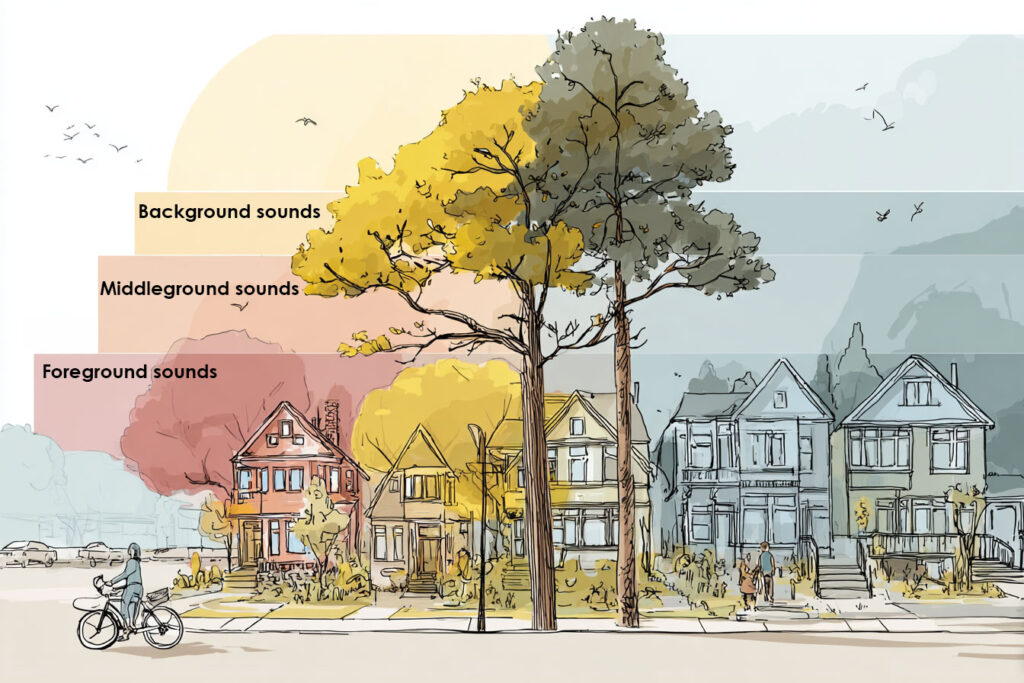
Think of your soundscape like a landscape with foreground, middle ground, and background.
Foreground sounds are close and clear: your own breathing, keyboard clicks, a conversation in the same room, your dog’s collar jingling.
Middle ground sounds are present but not dominant: voices from the next room, traffic on your street, a neighbor’s lawnmower, kids playing nearby.
Background sounds create atmosphere: distant freeway hum, passing airplanes, construction several blocks away, and the general city buzz.
In a healthy soundscape, you can distinguish these layers and hear sounds with depth. You have the ability to choose what to focus on.
In an unhealthy soundscape, everything competes. The background is just as loud as the foreground. You can’t filter out the noise. This is exhausting, even if you don’t consciously notice it.
Try this: Stand in your favorite spot at home. Identify one sound in each layer. Can you easily tell them apart?
Five Essential Terms
Here are words that sound experts use. You can use them too.
Hi-fi vs Lo-fi
A hi-fi soundscape is clear and detailed, with distinct sounds you can recognize individually. Imagine a quiet residential street where you can hear specific birds, identify your neighbor’s gate closing, and track someone walking. by.
A lo-fi soundscape is muddy. Everything blends together. A busy commercial strip with overlapping traffic, music from multiple stores, and construction creates a lo-fi sound.
Keynote sounds
These are the constant background sounds that define a place. You might not consciously notice them, but they’re always present.
Near water: wave sounds, foghorns, gulls. Commercial district: traffic hum, ventilation systems. Residential area: wind in trees, distant lawnmowers, dogs, children.
When keynote sounds change drastically (like a new freeway or a different airport flight path), the whole place feels different.
Sound signals
Sounds meant to grab your attention: sirens, car horns, crosswalk signals, school bells, backup beepers.
Soundmarks
A sound so distinctive it identifies a place. Maybe it’s the unique squeal of the bus around the corner near your stop, bells from a church two blocks away, the ice cream truck’s jingle every Thursday, or the call-and-response of crows in the park at dusk.
Soundmarks give a neighborhood character. They’re worth protecting.
Temporal patterns
Soundscapes change throughout the day, week, and year. Notice:
- What wakes you up?
- When is it loudest? Quietest?
- Weekday vs weekend differences
- Seasonal changes (windows open vs closed, leaf blowers, AC units)
How to Use This Vocabulary
This language becomes power when you need it.
Instead of: “The new development will be too noisy.”
Try: The loading dock faces residential homes and will create intermittent low-frequency sounds like backup beepers and truck engines during early morning hours when the current soundscape is quiet enough for open windows. This will block our access to natural ventilation.
Instead of: “My neighbor is too loud.”
Try: “Bass from music between 10 PM and 2 AM creates low-frequency vibration that penetrates shared walls. The intermittent nature makes it impossible to adapt. I’m requesting help establishing quiet hours that work for both households.”
Instead of: “Save our quiet neighborhood.”
Try: “Our neighborhood’s soundscape is characterized by birdsong, wind in mature trees, and children playing. We want to ensure new development preserves these acoustic qualities while accommodating growth. Can we discuss building orientation and buffer zones?”
The more specific you are, the more likely you are to get results.
A Simple Exercise to Build Your Sonic Vocabulary
- Choose a spot in or near your home where you spend time regularly.
- Listen for five minutes without distractions.
- Write down:
- Three specific sounds you hear
- Whether each is foreground, middle, or background
- Whether each is constant, intermittent, or rhythmic
- One word for how the overall soundscape feels
- Do this daily for a week at the same time and place.
- Notice patterns. What changes? What stays the same?
You’ll be surprised how much you hear once you start paying attention.
Words to Describe How Sound Feels
Sometimes the most accurate description isn’t technical, but emotional:
Spatial: intimate, expansive, enclosed, open, cluttered, spare
Emotional: welcoming, aggressive, peaceful, chaotic, comforting, alienating, energizing, draining
Texture: harsh, smooth, rough, soft, layered, flat
If your neighborhood soundscape feels aggressive and draining, that’s valid information. If it feels welcoming and energizing, that matters too. You don’t need permission to use these words.
Your Soundscape Is Worth Describing
You don’t need to be an expert to talk about sound. You live in your soundscape. You’re the expert on how it affects you.
But having words helps. It helps you communicate with neighbors, advocate with city officials, and participate in decisions about your environment.
Your neighborhood has a sound. Now you can describe it.
And that means you can help shape it.